Building a SaaS product is not simply a software development project. It is the process of turning a repeatable customer problem into a product that can be delivered, supported and improved at scale.
A successful SaaS platform needs more than a long feature list. It needs a clear target user, strong onboarding, reliable architecture, account and permission management, a sustainable revenue model, analytics, security, support processes and a roadmap driven by real usage.
This guide explains how businesses and founders can approach SaaS development in 2026—from idea validation and MVP planning to multi-tenant architecture, subscriptions, integrations, AI, security and scaling.
What Is SaaS Development?
Software as a Service, or SaaS, is software delivered over the internet rather than installed separately for every customer. Users generally access the product through a web or mobile application, while the provider manages the application, infrastructure, updates and ongoing product development.
SaaS development therefore involves both software engineering and product-system design. The platform must support customers repeatedly and efficiently rather than being rebuilt for every new client.
Common SaaS products include CRM platforms, HR systems, project-management tools, finance applications, industry-specific management systems, analytics platforms, workflow automation products and subscription-based business software.
Start With the Problem, Not the Feature List
One of the most expensive SaaS mistakes is building too much before proving that customers care about the core problem.
Before development begins, define the target customer, the problem they experience, how they solve it today, why the current approach is inefficient and what measurable improvement your product can create.
A focused product statement is more useful than a large backlog. If the team cannot clearly explain who the product is for and why that customer should switch, additional features will not solve the positioning problem.
Validate the SaaS Idea
Validation does not require a finished product.
Founders can interview potential users, map existing workflows, review competing products, test prototypes, create a landing page, collect early interest or work with design partners.
The objective is to reduce uncertainty before expensive engineering begins.
Useful questions include: Is the problem frequent enough? Is it painful enough? Who controls the buying decision? What alternatives already exist? What would make a customer switch? Which workflow creates the strongest initial value?
Define the MVP
A Minimum Viable Product should not mean a low-quality product. It means the smallest credible version that allows the team to deliver the core value proposition and learn from real usage.
A SaaS MVP might include authentication, organization setup, a focused primary workflow, essential user roles, a basic dashboard, necessary notifications, core administration and analytics.
Features that do not directly support activation, usage, payment, retention or the primary workflow should be challenged before they enter the first release.
Infroniz approaches Custom Software Development and SaaS Product Development by defining the business workflow first, then translating it into a practical first-release scope.
Design the User Experience Around Activation
For SaaS products, the first few minutes matter.
A user who signs up but never reaches the first useful outcome is unlikely to become a retained customer.
Onboarding should help users understand what to do next, configure only what is necessary, and reach value quickly. Empty dashboards, long forms, unclear terminology and unnecessary setup steps create friction before the product has demonstrated its value.
UX design should therefore consider signup, onboarding, empty states, primary workflows, errors, notifications, billing, settings and support—not just the visual appearance of dashboards.
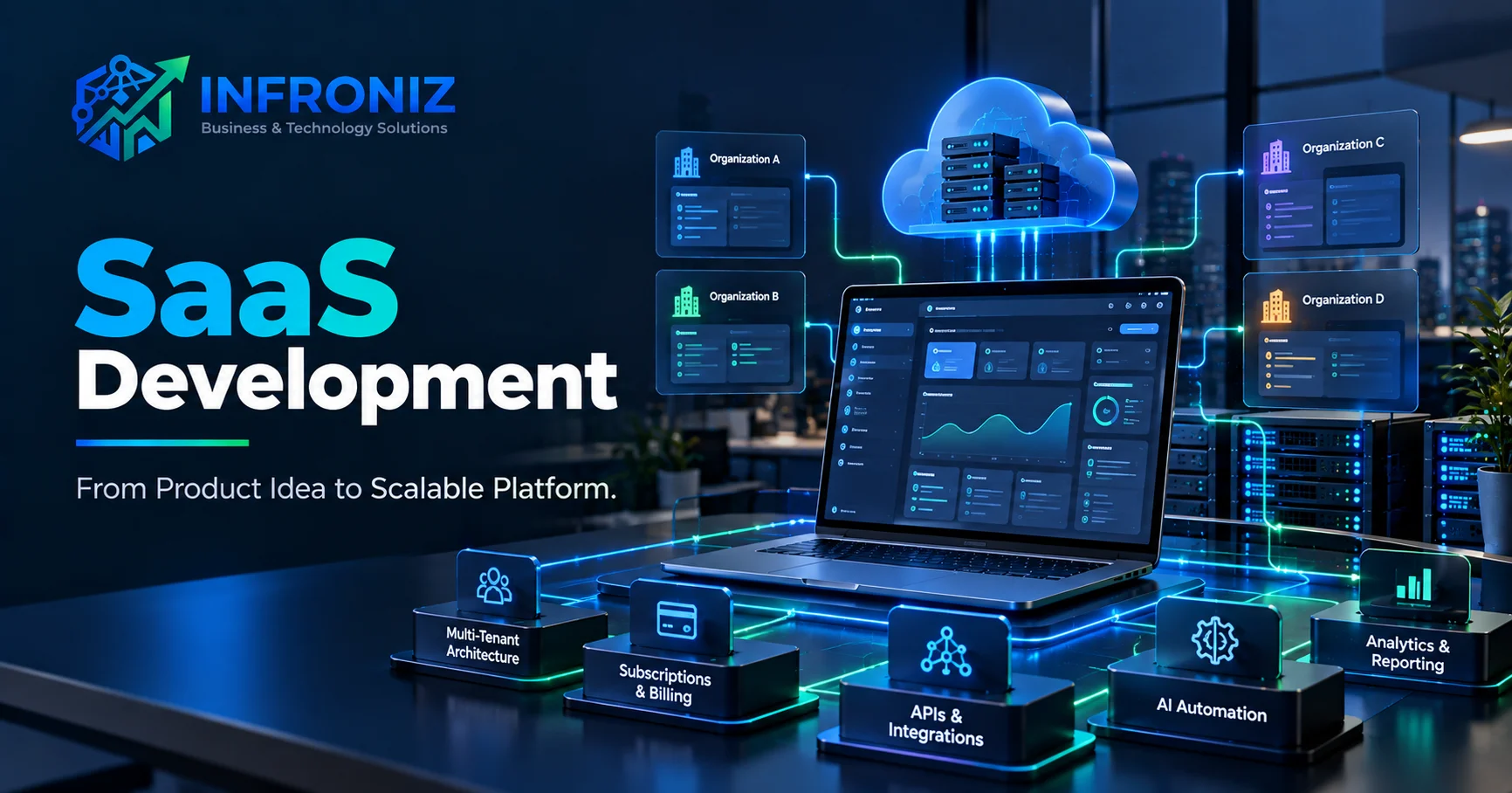
Multi-Tenant SaaS Architecture
Many SaaS platforms serve multiple organizations from one product environment. This is commonly described as multi-tenant architecture.
The application needs a reliable way to separate organizations, users, permissions, settings and data. Depending on the product, each tenant may have its own team members, roles, plans, limits, branding or configuration.
Tenant isolation is a critical architecture and security concern. A user from one organization must not gain unauthorized access to another organization's information.
The right data architecture depends on scale, compliance, customization requirements and the nature of the product.
Roles and Permissions
Most B2B SaaS applications eventually require more than one type of user.
A platform may include owners, administrators, managers, employees, customers, vendors or other specialized roles.
Permissions should be designed around actions and data access rather than only hiding navigation items. Backend authorization should enforce what users are allowed to view, create, edit, approve or delete.
Clear permission architecture also makes the product easier to scale when larger customers request more organizational control.
Subscription Plans and Monetization
SaaS monetization should reflect how customers receive value.
Common models include per-user pricing, tiered subscriptions, usage-based pricing, feature-based plans, flat monthly subscriptions or hybrid models.
Pricing architecture affects the product itself. The system may need plans, trials, usage limits, billing cycles, upgrades, downgrades, invoices, payment failures and entitlement rules.
Do not treat billing as a final screen added at the end of development. It is part of the product model.
APIs and Integrations
B2B SaaS rarely operates alone.
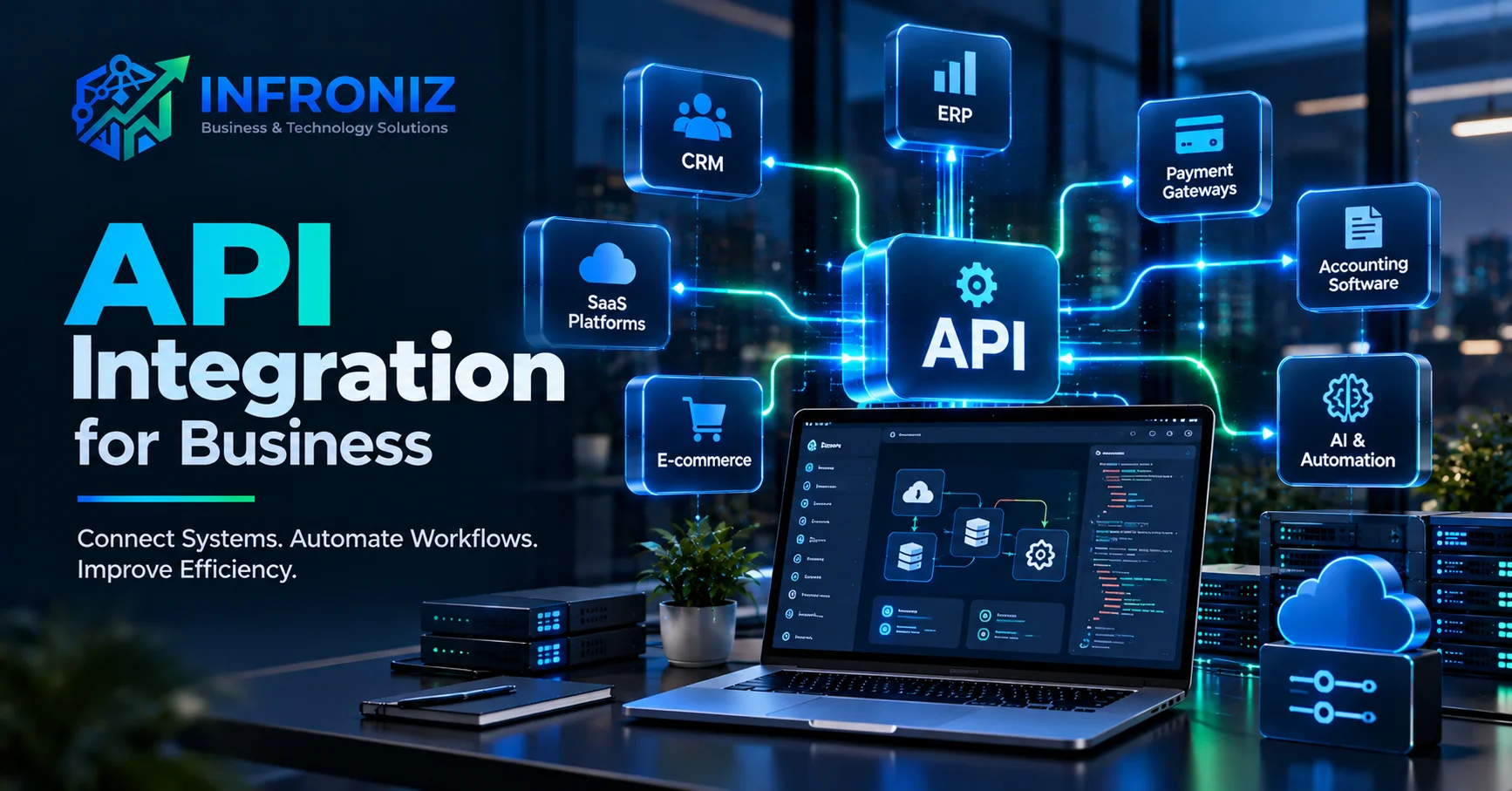
Customers may expect integrations with payment gateways, accounting software, CRM platforms, email providers, messaging services, cloud storage, analytics systems, identity providers and industry-specific platforms.
API & System Integration allows information to move between systems and can make the SaaS product more valuable inside a customer's existing workflow.
Integrations should be prioritized based on customer demand rather than adding a large marketplace before the core product has traction.
AI in SaaS Products
AI can create useful product capabilities when it is tied to a real workflow.
Examples include document extraction, natural-language search, intelligent classification, summaries, recommendations, support assistance and workflow automation.
However, adding a chatbot to a SaaS product does not automatically make the product more valuable.
AI should reduce work, improve a decision, make information easier to access or enable a workflow that was previously difficult.
Infroniz combines AI & Process Automation with Custom Software Development and API Integration where AI creates practical business value rather than being added only as a marketing feature.
Security and SaaS
A SaaS provider may store customer accounts, operational data, files, billing information or other business information. Security must therefore be considered throughout the product lifecycle.
Important areas can include secure authentication, multi-factor authentication where appropriate, authorization, tenant isolation, encrypted connections, database permissions, API security, secrets management, backups, audit logs, monitoring and dependency maintenance.
Security requirements should increase with the sensitivity of the data and the consequences of unauthorized access.
Infroniz can connect SaaS development with Cybersecurity & Firewall and infrastructure planning where the project requires broader security controls.
Analytics: Measure the Product, Not Just Traffic
Website visits and registrations do not tell you whether the SaaS product is working.
Product analytics should help answer questions such as: How many users complete onboarding? How quickly do they reach the first valuable outcome? Which features are repeatedly used? Where do users abandon workflows? How many trial users convert? Which customers become inactive? Why do customers cancel?
Useful SaaS metrics can include activation rate, trial-to-paid conversion, retention, churn, recurring revenue, expansion, feature adoption and time-to-value.
The exact metrics depend on the business model, but the product team should know which behaviors predict customer value.
Scalability Without Overengineering
A SaaS platform should be able to grow, but building for hypothetical millions of users before product-market fit can waste time and money.
Early architecture should be clean, secure, observable and capable of reasonable growth. Bottlenecks can then be addressed using real usage data.
Scalability can involve database design, caching, background processing, cloud infrastructure, file storage, queues, API performance, monitoring and deployment architecture.
The goal is not maximum technical complexity. It is an architecture that can evolve without requiring the product to be rebuilt every time usage increases.
Common SaaS Development Mistakes
Common mistakes include building too many features before validation, copying competitors without understanding customer needs, weak onboarding, unclear roles and permissions, ignoring billing architecture, overengineering infrastructure, underinvesting in security, launching without analytics and treating customer feedback as a list of feature requests.
Another major mistake is confusing custom client work with a SaaS product. A SaaS platform needs repeatable workflows. If every customer requires a completely different product, the business may become a services company disguised as SaaS.
How Much Does SaaS Development Cost?
There is no reliable fixed price for SaaS development because the scope can vary dramatically.
Cost depends on product complexity, number of roles, UX requirements, web and mobile platforms, multi-tenant architecture, subscriptions, payment integration, third-party APIs, AI capabilities, security, reporting, data migration, infrastructure and testing.
A focused MVP with one strong workflow can be substantially more efficient than attempting to build the complete long-term vision in version one.
The better approach is to define the business objective, identify the highest-value workflow and estimate a first release that can produce meaningful customer learning.
How Infroniz Can Help Build a SaaS Product
Infroniz Business & Technology Solutions can support SaaS products across strategy, design, development and supporting technology.
Relevant services include Custom Software Development, Web Application Development, Mobile App Development, AI & Process Automation, API & System Integration, Cybersecurity & Firewall Solutions, and IT Infrastructure & Networking.
A SaaS engagement can include product discovery, workflow definition, UX/UI design, MVP development, administration systems, multi-tenant architecture, dashboards, integrations, automation, AI features, deployment and ongoing product improvement.
The objective is not simply to deliver code. It is to build a product foundation that supports real users, measurable adoption and future growth.
Related Infroniz Guides
Only link to articles that are already published on the website when Day 9 goes live.
Recommended live internal links include:
Custom Software Development — /blog/custom-software-development-guide
AI Automation for Business — /blog/ai-automation-for-business
Web Application Development — /blog/web-application-development-guide
AI Workflow Automation — /blog/ai-workflow-automation
Cybersecurity for Small Business — /blog/cybersecurity-for-small-business
IT Infrastructure & Networking — /blog/it-infrastructure-networking-business-guide
Do not add links to future unpublished articles. Add new internal links later as the content cluster grows.
Frequently Asked Questions
What is SaaS development?
SaaS development is the process of designing, building, deploying and operating software delivered as an online service to multiple customers.
What is a SaaS MVP?
A SaaS MVP is a focused first version containing enough functionality to solve the core customer problem and generate real product learning without building the complete long-term roadmap.
What is multi-tenant SaaS?
A multi-tenant SaaS application serves multiple customer organizations while maintaining appropriate separation of their users, data, permissions and settings.
How long does it take to build a SaaS application?
The timeline depends on scope, UX complexity, user roles, integrations, billing, security, AI requirements and platforms. A focused MVP can be delivered much faster than a large enterprise SaaS platform.
Can AI be integrated into a SaaS product?
Yes. AI can support search, document processing, classification, summarization, recommendations, support and workflow automation when those capabilities solve a meaningful user problem.
Can Infroniz develop both web and mobile SaaS products?
Yes. Infroniz provides web application, mobile application, custom software, AI automation and integration services that can be combined according to the product requirements.
Final Takeaway
A scalable SaaS product starts with a narrow customer problem, not a large feature list.
Validate the problem, define the smallest valuable product, design onboarding around activation, build clean tenant and permission architecture, measure real product behavior and expand based on evidence.
If you are planning a SaaS product, replacing an internal system with a commercial platform, or rebuilding an existing SaaS application for growth, contact Infroniz Business & Technology Solutions to discuss the product, workflow and technical requirements.