A business can report a profitable month and still struggle to pay suppliers, salaries or rent on time. The problem is often timing: sales are recorded today, but customers pay later, while expenses must be settled on fixed dates. Cash flow forecasting helps owners see that timing problem before it becomes urgent.
This guide provides a practical weekly planning method for small businesses. You will learn what to include in a 13-week forecast, how to estimate customer receipts, how to review cash gaps and which decisions a forecast can support. The illustrative figures below are examples, not actual Infroniz or client results.
What is cash flow forecasting?
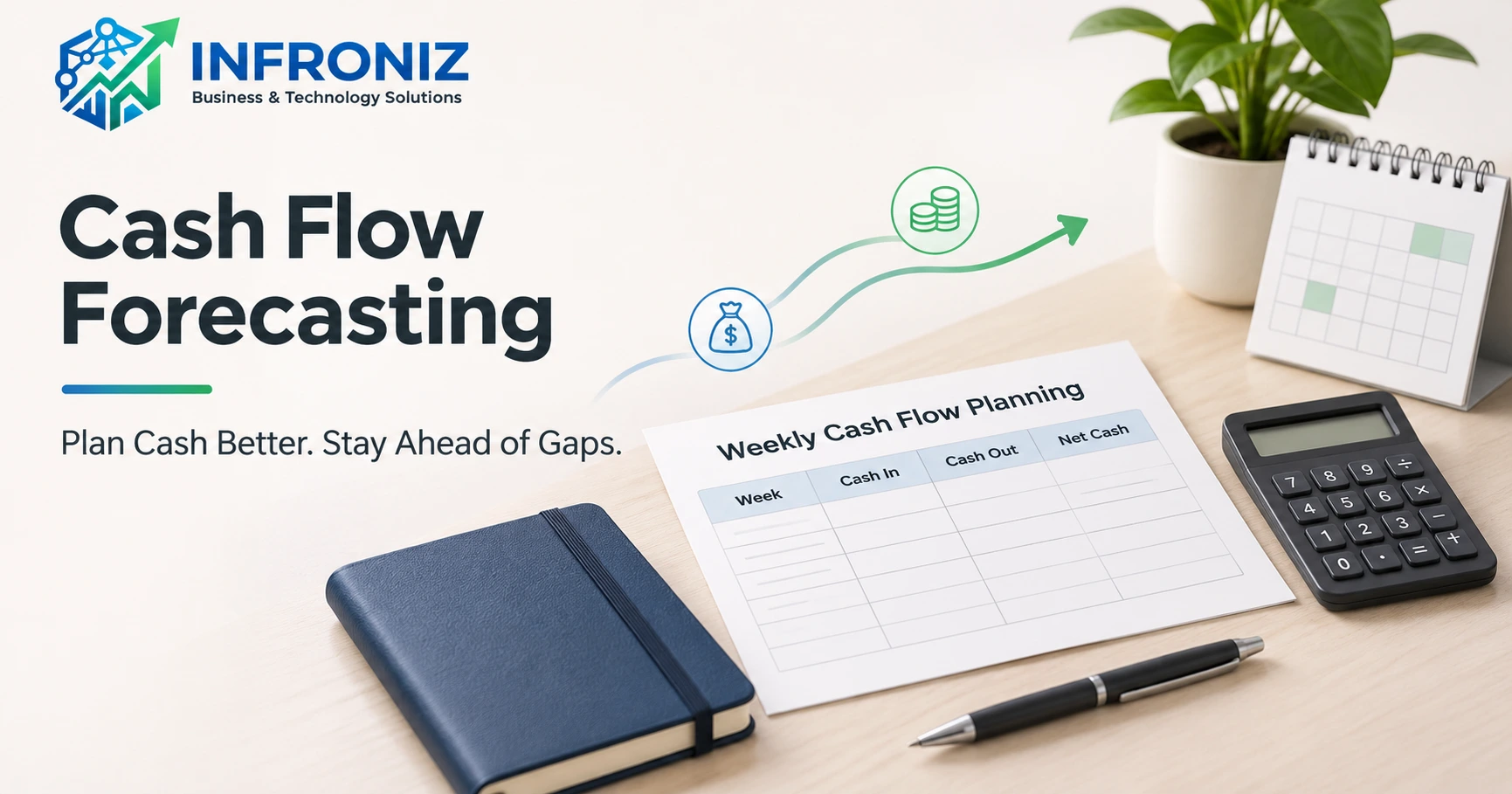
Cash flow forecasting is an estimate of money expected to enter and leave a business over a defined period. A short-term forecast focuses on the dates cash is likely to move, rather than solely on the dates revenue or expenses are recorded.
For many small businesses, a rolling 13-week forecast is useful because it offers enough visibility to identify near-term pressure while remaining detailed enough to update with invoices, payroll, rent, tax-related payments, supplier terms and planned purchases.
A forecast is not a guarantee. Actual payments may arrive earlier or later, costs can change, and unexpected events may occur. Its value comes from making assumptions visible and allowing decisions to be adjusted.
Cash flow is not the same as profit
Profit describes whether income exceeds expenses over an accounting period under the applicable accounting approach. Cash flow describes when money actually moves through the business.
Imagine a company completes a project and issues an invoice in the current month. The sale may contribute to reported revenue, but if the customer pays 45 days later, that money cannot pay this week’s expenses. Similarly, buying equipment may create an immediate cash outflow even though accounting treatment of that purchase differs.
This is why an owner should review both financial performance and near-term cash availability. One does not replace the other.
Why a 13-week cash flow forecast works
A 13-week view gives roughly one quarter of forward visibility while encouraging weekly review. It can reveal periods when multiple bills fall due before expected customer receipts arrive.
Compared with a high-level annual budget, a short-term cash forecast is easier to connect to operational decisions: following up on an overdue invoice, scheduling a purchase, discussing payment terms with a supplier or deciding whether a new commitment is affordable.
The weekly view also keeps the model honest. As the next week arrives, planned receipts can be compared with actual bank movements and revised based on evidence.
Step 1: Start with the bank balance you can actually use
Begin with the opening cash balance at the start of week one. Use an up-to-date reconciled bank balance and identify any funds that are restricted, committed or otherwise unavailable for operating payments.
Do not add approved credit facilities to bank cash without separately identifying them as financing options. A forecast should distinguish cash already held from funds that might be available subject to lender terms or approvals.
If the business uses multiple operating bank accounts, decide which accounts belong in the forecast and avoid double-counting transfers between them.
Step 2: Forecast cash receipts by expected payment date
List major customers, open invoices, contractual payment dates, historical payment behavior and expected new cash sales. An invoice due next Friday may need to be placed in a later week if that customer regularly pays after the due date.
Separate confirmed expected receipts from uncertain opportunities. A quote awaiting approval is not the same as an invoice likely to be settled. Sales-pipeline forecasts may be useful for longer-term planning, but should not automatically be treated as cash in the bank.
For each material receipt, record the source, expected amount, forecast payment week, person responsible for follow-up and confidence or supporting evidence.
Step 3: Forecast cash payments by due date
Include payroll, rent, utilities, supplier payments, subscriptions, financing payments, necessary equipment purchases and other operating commitments. Include tax-related amounts only where a qualified professional or the business’s records establish their applicability and due dates.
A useful forecast separates relatively predictable recurring payments from variable and discretionary spending. That distinction helps owners see which payments are essential and which purchases may be rescheduled if a cash gap appears.
Avoid combining several uncertain payments into one unexplained expense line. More detail is valuable when the amount is material or the due date could change.
Step 4: Calculate each week’s closing balance
The basic calculation is: opening cash + expected cash received − expected cash paid = forecast closing cash. The closing balance becomes the next week’s opening balance.
The following simplified example is hypothetical and uses PKR solely to show the calculation. It excludes financing movements and any restrictions on cash.
Illustrative 3-week example (PKR)
|
Line item |
Week 1 |
Week 2 |
Week 3 |
|
Opening cash |
250,000 |
220,000 |
110,000 |
|
Cash received |
180,000 |
150,000 |
230,000 |
|
Cash paid |
210,000 |
260,000 |
180,000 |
|
Closing cash |
220,000 |
110,000 |
160,000 |
Interpretation: The example stays cash-positive across all three weeks, but its buffer shrinks substantially in Week 2. The useful question is not just “Will we run out?” but “What happens if a large Week 2 receipt arrives a week late?”
Step 5: Set a minimum cash buffer and test scenarios
Choose a minimum operating cash buffer based on upcoming obligations, volatility and access to funding. There is no universal safe amount: a business with weekly payroll, volatile customer payments and limited financing needs a different reserve from a business with predictable prepaid sales.
Test at least three conditions: the base forecast; a delayed-receipt scenario; and a higher-cost or unexpected-payment scenario. If the closing balance falls below the chosen buffer, the team should identify an action before the gap arrives.
Potential actions may include earlier invoice follow-up, staged purchasing, negotiated payment schedules, reduced discretionary spending or a conversation about appropriate financing. Each has trade-offs and should be assessed against actual commitments.
Step 6: Run a 20-minute weekly review
A forecast becomes useful when someone owns its maintenance. Set a recurring weekly review with the owner, finance lead or relevant operations manager.
First reconcile the previous week: which receipts and payments happened, and which moved? Next update the following 12–13 weeks using new invoices, purchase commitments and customer information. Finally note the three largest expected risks and the people responsible for action.
The review should produce decisions, not just an updated spreadsheet. Record assumptions, owners and follow-up dates so the same uncertainty is not carried forward without investigation.
Five warning signs to watch
1. Sales are increasing while the bank balance remains tight. Check collection timing and the amount tied up in receivables.
2. One or two customers account for most expected receipts. Run a delayed-payment scenario for those customers.
3. Several supplier bills land in the same week. Check whether purchasing or payment schedules can be better coordinated.
4. Forecast payments frequently differ from actual payments. Improve source records and review assumptions instead of simply changing totals.
5. Equipment and expansion plans are approved without considering the cash calendar. Evaluate the timing of each commitment, not only its estimated profitability.
How invoicing records improve a forecast
Cash forecasts are only as useful as the underlying records. Quotation history can support pipeline visibility; issued invoices show amounts expected from customers; payment records help distinguish settled and outstanding balances.
For a small business, keeping customers, invoices, quotations and payment records organized can reduce the manual work needed to build the receipts side of a cash forecast. However, an invoicing tool by itself does not guarantee collections or replace cash planning.
Infroniz Invoices is a web application for managing invoices, quotations, companies and payments. Businesses can explore it as an operational tool for organizing records, while using a separate forecast or finance process to assess future cash needs. Check current product availability and terms on the official Infroniz site before publishing any “free” or feature-specific claim.
When to seek financial advisory support
A simple spreadsheet may be enough for an early-stage business with limited transactions. Additional support becomes useful when a company has several payment cycles, uncertain collections, inventory purchases, financing commitments or multiple departments.
Financial advisory and consultancy can help clarify what records are needed, how to interpret cash movements, which assumptions matter and how reporting can support operational decisions. The appropriate scope should be confirmed for each business; cash flow projections are estimates, not guaranteed financial outcomes.
Infroniz Business & Technology Solutions offers Financial Advisory & Consultancy alongside Technology & Development and IT Infrastructure & Networking. This combination can be useful when financial visibility depends on better business records and practical software workflows.
Frequently asked questions
How often should a small business update its cash flow forecast? A weekly review suits many short-term 13-week models, with more frequent updates when cash is tight or transactions are volatile.
What is the difference between cash flow forecasting and budgeting? A budget sets planned income and expenses over a period, while a cash forecast estimates the timing of actual inflows and outflows.
Should unpaid quotations be included as cash receipts? Not as confirmed receipts. Potential work can be tracked separately with transparent assumptions about whether and when it might convert into cash.
Can a profitable business still have cash flow problems? Yes. Customer payment delays, inventory purchases, debt commitments and other timing differences can create short-term shortages.
Does an invoice management tool automatically produce an accurate forecast? No. Accurate forecasting also requires payment timing assumptions, expected outgoing payments, reconciled balances and regular review.
Is a 13-week forecast appropriate for every business? It is a useful short-term method for many businesses, but the planning horizon should match the company’s payment cycles and management needs.
Final takeaway: Make payment timing visible
A cash flow forecast does not need to be complicated to be useful. Start with the cash available, list realistic customer receipts, schedule payments by expected date, calculate the weekly closing balance and review it regularly.
The objective is not to predict every transaction perfectly. It is to recognize potential pressure early enough to consider options, communicate with stakeholders and make better-informed commitments.
Need help organizing your reporting or planning processes? Discuss your requirements with Infroniz Business & Technology Solutions at Info@infroniz.com, WhatsApp 0303-8679604 or https://infroniz.com/contact.